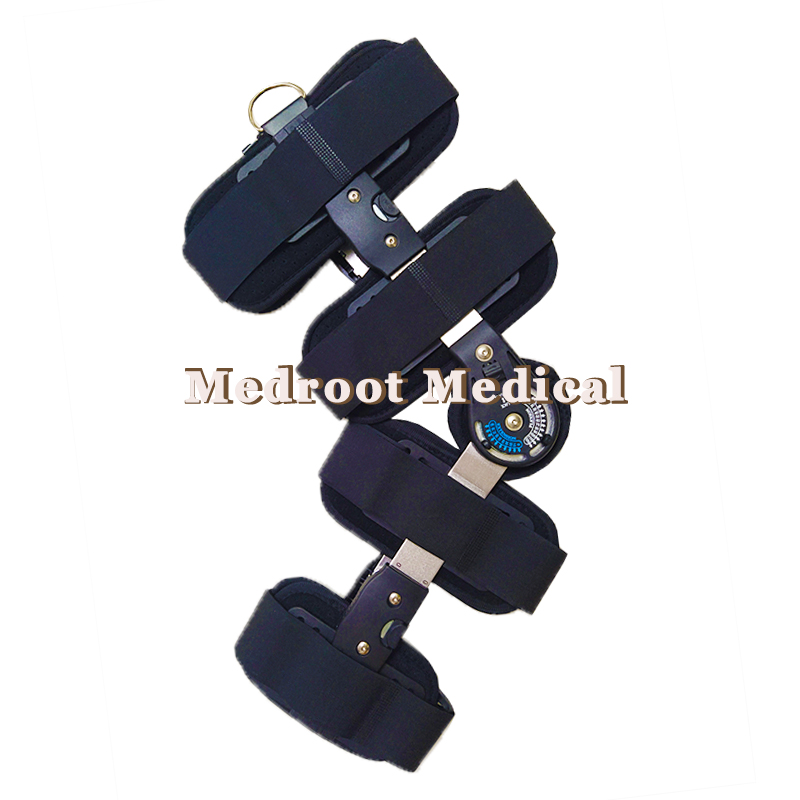
After a knee injury, clinicians usually prescribe different types of knee immobilizers based on the patient’s specific condition. For many common clinical scenarios, an adjustable hinged ROM knee splint is the more suitable choice to support safe and steady recovery.
1. Conservative treatment for mild injuries.
For patients with minor ligament sprains, slight meniscus irritation or mild post-traumatic swelling, full rigid immobilization is unnecessary and may even slow down natural healing. An adjustable knee splint lets you lock the joint at a limited, safe flexion angle. It delivers enough stability to prevent accidental twisting or overextension, while permitting gentle controlled movement that reduces abnormal pressure on injured soft tissue. This balance of protection and mild mobility helps patients go through daily activities safely, without worsening their symptoms.
2. Rehabilitation training after clinical treatment.
After knee surgery or interventional care, progressive guided movement is essential for restoring joint function. The hinged ROM knee splint offers firm structural support for the knee, and its adjustable hinge system allows clinicians to precisely set the allowed flexion and extension range. This controlled motion protection makes it a core tool in rehabilitation, helping patients perform gradual strength and mobility exercises safely, without exceeding the healing capacity of recovering tissues.
3. Pain relief during post-treatment daily movement.
Many patients still experience moderate residual pain in the early recovery stage. An adjustable knee splint stabilizes the joint when patients walk or stand, effectively reducing extra stress on sensitive areas and easing discomfort during activity. This gentle, ongoing support makes daily tasks far more manageable and creates more favorable conditions for consistent recovery.
Medroot Medical advises orthopedic clinics to keep several adjustable knee braces available for in-office trial fitting. When patients show the above symptoms, allowing them to test the brace on site helps them find a perfectly matched rehabilitation orthosis for their individual recovery needs.
Please don’t hesitate to contact Medroot Medical for more information.